Integrated records
Admissions, fees, academic progress, and finance share the same student and staff record instead of disconnected files.


Search products, services, projects…
University management
Admissions, student records, examinations, portals, finance, HR, hostel, and campus administration in one university system, including Bologna-aligned academic structures.
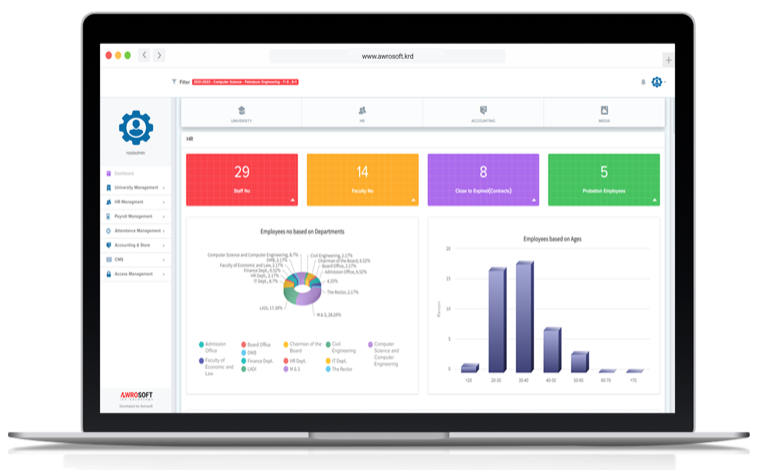
Why institutions use it
Admissions, fees, academic progress, and finance share the same student and staff record instead of disconnected files.
Portals and role-based workspaces keep each group inside the services they are responsible for.
The platform can be hosted with Awrosoft or installed on the institution’s own infrastructure.
Permissions, activity logs, and audit history make it possible to review who changed what.
Academic structure
Hevra IUMS supports semester-based study structures used by universities and institutes in the region. Programmes, modules, and student workload can be organised around credit-bearing courses for autumn and spring terms.
When a student completes a programme, earned credits can be calculated alongside institutional measures such as FSR and CGPA, so academic progression and award decisions sit on a consistent record.
Deployment
Installed on institutional hardware and operated with the university’s IT team. Higher initial setup, with long-term control remaining inside the institution.
Hosted and maintained as a managed service. Lower starting infrastructure burden, with ongoing operation handled under an agreed support model.
Modules
Receive applications, documents, and eligibility checks without repeating campus visits for every step.
Keep the student file current from admission through enrolment, study, and completion.
Register accepted students, issue identifiers, and open access to academic services.
Define programmes, courses, timetables, and teaching assignments.
Capture marks, publish results, and keep assessment history with the academic record.
Record class attendance, issue work, and return feedback in one academic workspace.
Track module credits and programme completion against the institution’s academic rules.
Give students a clear view of schedules, assessments, fees, and academic status.
Give faculty academic information, class lists, assessments, and campus notices.
Connect admission, registration, and payment records so finance and student services share the same status.
Coordinate rooms, admissions, charges, and current resident records.
Support borrowing and catalogue access as part of the wider student service record where required.
Publish campus notices and events to students and staff from one administrative source.
Maintain staff records, appointments, departments, and roles.
Record working time, absence, and leave requests through defined approvals.
Calculate salaries, deductions, and related reports against attendance and HR records.
Keep institutional accounting connected to fees, stores, payroll, and operational entries.
Track procurement, stock, issue, and institutional assets.
Control who can see and change records, and keep a reviewable history of administrative action.
Configuration tiers
Tiers describe a typical starting scope. The implemented package is confirmed during discovery against programmes, campuses, and administrative responsibilities.
Core academic operation
Campus and administration
Full institutional platform
Implementation model
Discovery establishes responsibilities, data, approval paths, integrations, reports, and the operational conditions the platform must support. Delivery then moves through configuration, validation, rollout, training, and continued improvement.
Map workflows, responsibilities, data, and constraints.
Shape roles, modules, integrations, and reporting.
Test with real operational scenarios and responsible teams.
Roll out with training, support, and measured improvement.
Explore Hevra IUMS
Bring the workflow, constraints, and existing systems. Awrosoft will help define a practical product and implementation path.